


There are many devices where resistance does not change with increasing temperature.
For example heaters; here heating wires are used whose resistance is only slightly dependent on temperature. Such a material could be material Constantan, for example. However, there are also products such as electric motors in which copper wire is often used. The resistance of copper wire depends on temperature.
Copper wire has a positive temperature coefficient, meaning that the higher the temperature, the higher the ohmic resistance.
Under no circumstances should the temperature dependence of the copper wires be neglected in a resistance measurement, otherwise a measurement error will occur.
To enable a temperature-independent comparable measurement, the ohmic data are related to temperature. This is set by default to 20°C in many countries. In very hot regions, it can sometimes be 25°C.
If you know the temperature of the resistance to be measured, the measured resistance value can be converted to the resistance that would exist at the reference (20°C). We use ambient temperature compensation as well as object temperature compensation.
There are conversion formulas for the different resistor types. These conversions are stored in our test systems including the MotorAnalyzer 1 and MotorAnalyzer 3, MTC2-R7, MTC3, GLP2-Modular/Basic and the GLP3.
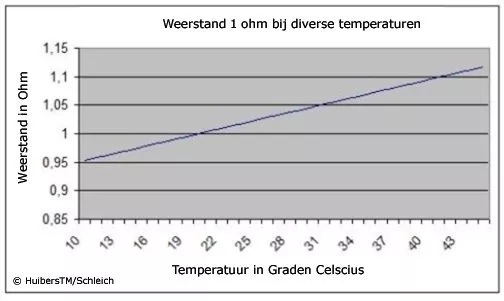
Copper wire shows a temperature behaviour with respect to resistance that can be seen in the graph below.

Increasing the temperature from 20°C to 30°C causes an increase in resistance of almost 5%. If in summer, the temperature in a production hall rises to 35°C, this directly affects the final result.
For a test plan with +5% tolerance on the ohmic value, the tester will immediately give a rejection (NIO). The test object in this case is not a reject, but the influence of temperature is present if one will perform resistance measurements without ambient temperature compensation.
The relationship between hot and cold copper resistance depends on the difference temperature and is as follows:
RTemp = R20 * (1 + α20 * ΔTemp)
The individual elements of this equation mean the following:
RTemp = value of resistance at temperature (Temp)
R20 = value of resistance at 20°C
α20 = temperature coefficient of the resistance material
ΔTemp = temperature difference between the temperature of the current resistor and 20°C
This formula can be converted to calculate the reference R20:
R20 = RTemp / (1 + α20 * ΔTemp).
Related blogs

Function tester
High-voltage tester
Testing light management today: from DALI to DMX. What you really need to safeguard in production
View article

Electric motor testing
Function tester
Hot hipot during functional testing: maximum assurance that all circuits are active
View article
Gijsbert at IONIO is here to help you.
At IONIO, we not only supply advanced testing and measurement systems, but also offer clear and expert advice to optimise the testing of your product.
Find out how we can improve your business processes. A consultation can be scheduled in no time!










Also collaborate on technical challenges?
Then you have come to the right place at IONIO!