


Home / Products / MTC3 R2 universal winding tester


MTC3 R2 universal winding tester
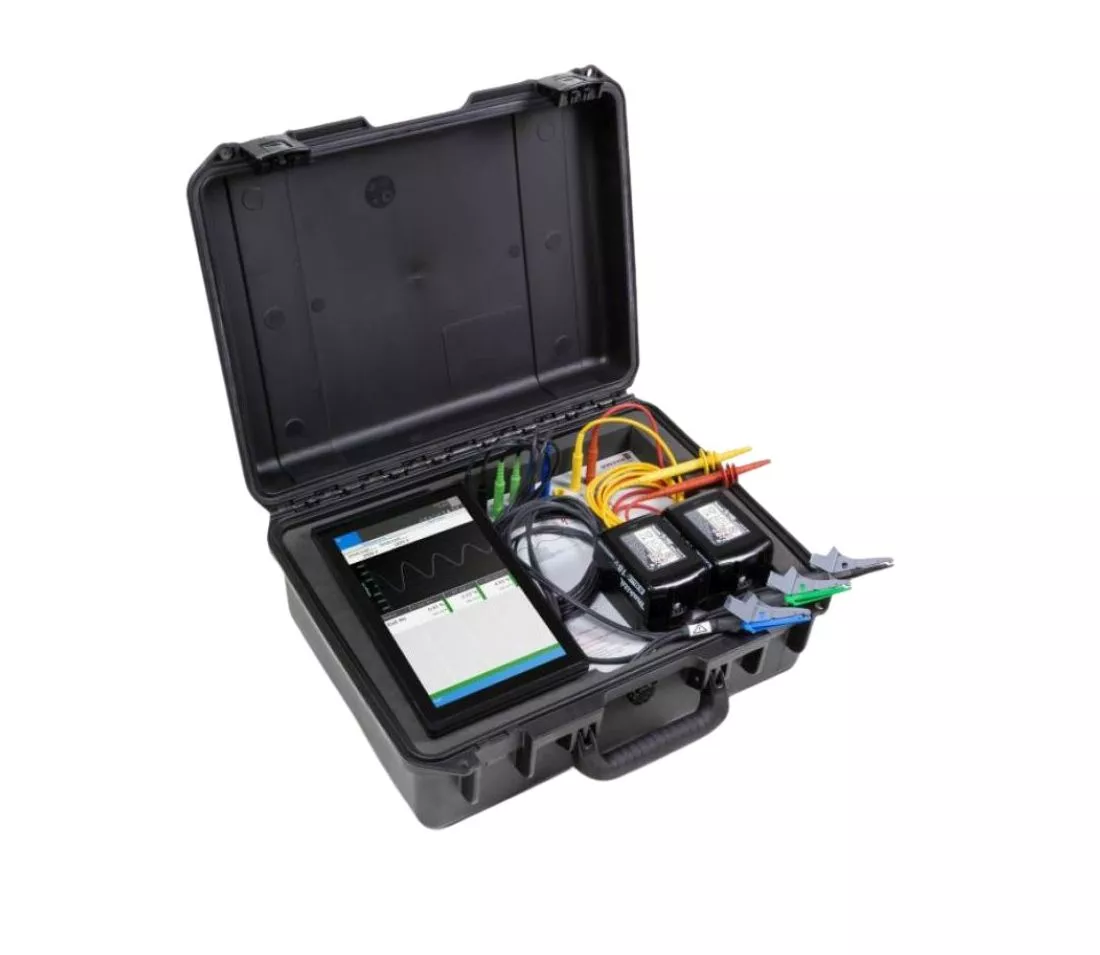
The MTC3 R2 is the new generation of the Schleich universal winding test system. It tests coils, stators, rotors, electric motors and transformers fully automatically in a single test sequence. Every system is configured for your application. IONIO supplies, installs and maintains the MTC3 R2.
What is new in the MTC3 R2?
Schleich has updated the MTC3 in several areas. These are the differences from the previous MTC3:
- New operator software with a simpler layout and fewer steps
- The surge test for partial discharge (PD) measurement is three times faster, with up to 50 measurements per second, which shortens the cycle time considerably
- Twice the impulse current in the surge test, up to 2000 A
- A wider measuring range for the insulation resistance test, up to 1 TΩ
- More accurate and more repeatable measurement results
- A completely new PD measurement with pC calibration, based on IEC 60270
- A comprehensive self-test that detects system faults automatically
- Three new housings: a robust console housing, a 19″ rolling container and a 19″ control cabinet
Do you have an MTC3 of the previous generation? You can still find it on the page MTC3 universal motor tester. We also provide service and calibration for existing systems.
What do you use the MTC3 R2 for?
The MTC3 R2 is designed for development, production and test laboratories. It tests windings from 0.1 W to 500 MW: coils, stators, rotors, electric motors, generators and transformers.
You connect the test object once. The MTC3 R2 then switches between the connections and test methods by itself. At the end of the test sequence you get a clear GO or NO GO.
Which tests does the MTC3 R2 perform?
The surge test, the insulation resistance test with automatic PI measurement and the DC high-voltage test are standard. They go up to 6, 12 or 15 kV, depending on the version. Do you need higher surge voltages, up to 50 kV? Then take a look at the MTC2 R7. You add the tests you need:
- Partial discharge at surge voltage, according to IEC 61934 and DIN EN 60034-18-41
- AC high-voltage test up to 6 kV and 1 A, higher values on request
- Protective earth test up to 30 A
- Partial discharge at AC high voltage, with automatic measurement of the inception and extinction voltage (PDIV and PDEV)
- Four-wire resistance measurement from µΩ to 100 kΩ, with temperature compensation
- Inductance measurement with an LCR bridge
- Rotating field test with a static probe
- Temperature sensor test
Surge test with patented evaluation
In the surge test, the MTC3 R2 compares the surge wave with a stored reference, or it compares the three phases with each other. You can combine the evaluation methods: tolerance band, error area ratio (EAR), phase comparison, reference comparison, correlation and peak-to-peak. Correlation and peak-to-peak are patented by Schleich.
The system largely selects the settings for maximum sensitivity by itself and corrects the test voltage automatically. Also read how high the test voltage of a surge test may be.
Measuring partial discharge
The PD test finds weak spots in the insulation that a normal high-voltage or surge test does not detect. Examples are enamelled wire touching the laminated core, a missing phase separator or air bubbles after impregnation. On a stator you measure with an antenna, on an enclosed motor with a coupler in the test lead.
The R2 has a new PD measurement with pC calibration, based on IEC 60270. Read more in partial discharge measurement on low-voltage machines and motors on a frequency inverter.
Configuration and housing
You configure the MTC3 R2 according to the Schleich Modular Concept. You choose:
- The base unit
- The number of winding connections
- The number of temperature sensors
- The test methods you need
The system can be expanded to 150 connections.
You calculate the number of connections as follows: number of winding connections + 2 × number of temperature sensors. A motor with 6 winding connections and 2 temperature sensors therefore needs 10 connections. The connection for the laminated core is standard in the base unit and is not counted.
There are three housings: a console housing, a 19″ rolling container or a 19″ control cabinet. You use the MTC3 R2 in three ways:
- As a manual test station, with a test cover, a two-hand start or a light curtain
- Semi-automatically
- Fully automatically in a production line, also as a double or multiple station
Software, data and connectivity
The test software runs on Windows on the built-in industrial PC. You store test plans and results locally or centrally in an SQL database on the network. If the network fails, the system keeps testing locally and transfers the results to the server later.
Statistics (trend, Gaussian distribution, FPY), test reports, label printing and barcode reading are part of the software. For automation there are RS232, Ethernet, digital I/O, CAN, EtherCAT, PROFIBUS, PROFINET and DeviceNet, among others. The MTC3 R2 exchanges data with ERP, MES and CAQ systems. With the built-in script functions you control valves, cylinders and limit switches, just like with a PLC. See also Schleich automation.
Safety
The safety circuit complies with PL e, SIL 3 and Cat. 4. The MTC3 R2 has two-channel safety inputs according to EN 50191, a built-in emergency stop and connections for warning and result lamps. Schleich declares that the MTC3 R2 complies with the Low Voltage Directive and the EMC Directive.
Why buy the MTC3 R2 from IONIO?
We help you choose the right configuration, supply and install the system, and provide training, maintenance and calibration. Calibration can be done on site or remotely.



Gijsbert at IONIO is here to help you.
At IONIO, we not only supply advanced testing and measurement systems, but also offer clear and expert advice to optimise the testing of your product. Discover how we can improve your business processes. A consultation can be scheduled in no time!