


Partial discharge measurement (PD) to assess the windings of low-voltage machines for suitability for frequency converters and general insulation strength
Introduction
Partial discharge tests have become increasingly important for assessing the insulation of electrical machines in recent years. This is particularly due to the huge increase in frequency converters for motor control. From our years of experience, many users talk about partial discharge testing, but have no precise idea of what partial discharge exactly means.
This description is intended to shed some light on the test method. It is less a scientific explanation than a generally understandable description of the measurement method and its applications.
What is partial discharge?
The typical “complete breakdown” is known from the classic high voltage AC test.

Figure 1 – Damaged conductor near the laminated core
Electrical machines are usually rated as follows: “The machine must not malfunction or have excessive leakage current.”
Review of: “What is too much current during the high-voltage test?” is no longer so simple.

Figure 2 – Breakdown or capacitive leakage current
In manufacturing, the maximum allowable current during the high-voltage test can be determined and specified from comparative measurements. However, this current limit is usually not available to the person taking measurements during repairs. Depending on the capacity of the insulation in the machine, the current is low for smaller electrical machines and correspondingly higher for larger ones.
Experienced professionals often feel that too much leakage current runs through the machine and/or that crackling noises occur during the high-voltage test. In such cases, there is no complete failure; partial discharge effects occur. These need to be reliably measured and analysed.
In the case of partial discharge, there is only a breakdown in part of the insulation in the sense of the word “partial…”.

Figure 4 – Partial discharge between touching windings
This partial area is a partial isolation weakness or bad area.

Figure 5 – partial discharge in a highly loaded section
This weak point is overloaded during electric motor operation or during the high voltage test. The weak point cannot withstand this increased load and, as a result, partial breakdown occurs in this partial area. This partial breakdown is called partial discharge. However, the remaining insulation still withstands the increased voltage load, so no complete breakdown occurs.
The following diagram illustrates the basic structure of insulation. High voltage is applied between two electrical conductors (e.g. winding and winding).

Figure 6 – Partial discharge illustrated using an equivalent circuit diagram
The electrical conductors are separated from each other by the insulation. In a completely homogeneous case, the insulation can be thought of as a large capacitor (CIso). However, due to a defect in the insulation, there may be spatial areas that are locally overloaded by a high electric field strength (CLuft). This is shown in the centre of the diagram. Partial discharge occurs in this overloaded subarea.
The consequence of this partial discharge is a slow but steady damage of the still functional parts of the insulation system. Exactly according to the principle of “constant dripping hollows out the stone”, the permanent partial discharges continuously lead to an enlargement of the damaged area. This inevitably leads to the still functional insulation soon no longer withstanding the load. This leads to a complete failure and thus a faulty electrical machine.
The aim should always be to prevent partial discharges in the electrical machine. It is only a matter of time before even small partial discharges destroy a machine.
Partial discharge is a voltage-dependent physical effect. If the voltage increases, at some point partial discharge will also occur. The only question is how high the test voltage should be. The answer lies in the application of the electrical machine. Depending on that, the test voltage for partial discharge should be chosen.
Electrical machines on industrial networks without frequency converters
An electrical machine that operates directly on the three-phase mains without a frequency converter is loaded only by the mains voltage and occasionally by switching spikes. In this application, it makes no sense to test the machine with very high test voltages for freedom from partial discharge.
High-voltage machines
High-voltage machines logically need a test voltage adapted to the high operating voltage to test the absence of partial discharge. The high operating voltage requires a special, highly resilient insulation system. The test voltage must therefore also be selected accordingly high.
Electrical machines on industrial networks with frequency converters
Electrical machines used on frequency converters should be tested for the absence of partial discharge with a higher test voltage. Why is this necessary? It is not immediately clear why a machine with a frequency converter needs to be tested with a higher test voltage. The following question can be asked How can a high voltage occur on electrical machines with a frequency converter? The answer lies in the basic functional operation of the frequency converter. In a variable speed drive, the single-phase or three-phase AC voltage supplied is first rectified and then smoothed and stored in correspondingly large capacities. The charging or shielding capacity in the inverter is often referred to as the DC link. The theoretical maximum DC voltage level in the DC link is the result of the RMS value of the mains voltage multiplied by √2. The DC voltage level is thus the peak value of the RMS value of the supply network.

Figure 7 – Basic circuit of the frequency inverter
Modern high-speed electronic switches are used to chop the stored DC voltage back into AC voltage. The result is not a pure sine wave, but a signal composed of square-wave pulses.

Figure 8 – Sinusoidal signal modelled from square wave pulses
The amplitude of the square-wave signal cannot be changed because the electronic switches switch the DC voltage to the electric motor or not.
However, the pulse duration (duty cycle of the electronic switches) can be varied by the inverter. By varying the pulse width, a sine wave is simulated. This process is called pulse width modulation (PWM).
In recent years, the almost rectangular pulses have acquired an increasingly steeper edge. This is the aim of semiconductor manufacturers of electronic switches to keep the power loss in the switch as low as possible during the switching phase. This is because the main losses (heating of the semiconductors) occur during the switching phase. The faster the electronic switch switches, the lower the losses and the lower the cooling effort in an AC drive. From an AC drive manufacturer’s point of view, high edge efficiencies are therefore the goal of development.
From the point of view of electrical machinery manufacturers, high steep edges are a major problem. The reason: steep edges lead to voltage spikes during switching (1).

Figure 9 – Rectangular signal with high edge smoothness and surge peaks
This is because in electrical engineering, square-wave signals basically exist only on the basis of composite sine-wave signals of different frequencies and different amplitudes. The steeper the slope of the square wave, the higher the frequency of the sine wave signals used to “mimic” the slope. The amplitude of the sine wave signals also increases. The voltage peaks become even higher if the electric motor is connected via a longer cable.
If the high-slope signals are now connected to a coil (i.e. the electric motor), the high-frequency components of the square-wave signal are filtered out at the coil. These high-frequency signal components drop out at the first windings of the winding. As a result, the winding is particularly heavily loaded at the beginning during frequency converter operation. The following diagram clearly shows the relationship between the steepness of the high edges and the resulting voltage drop across the winding of a phase.

Figure 10 – Voltage curve across the winding as a function of flank steepness
There is a very good article on the level of the overvoltage pulse (10). Here, a correlation between the overvoltage pulse and the rise time is determined. The value of the resulting overvoltage is multiplied by the DC link voltage UDC to obtain the absolute value of the overvoltage. Depending on the rise time, 4 voltage ranges of the machine were defined.

Figure 11 – Voltage ranges I – IV with overvoltage factor as a function of rise time
Measurement methods: current pulse or high-frequency measurement?
We mentioned at the beginning that partial discharge occurs at weak points in the insulation when the load becomes too high. Since leakage current does not increase measurably when partial discharge occurs, the question arises, “How can partial discharge be measured?”. If something discharges and there is still an external voltage on the device under test, charge will immediately reappear. This means that partial discharge can be measured directly via charging. The charge pulse is only a few nanoseconds wide. It is a very fast, high-frequency current pulse. Measurement technology must therefore be able to detect these fast pulses.

Figure 12 – Partial discharge test on motor/generator or stator with coupling for the high-frequency current pulse
The PD coupler is integrated into the device or can be simply connected to the test leads of the device under test.
The discharge signal is emitted electromagnetically in parallel with the discharge. This is similar to an electric spark or a lightning flash. Incidentally, the term radio operator, radio device or radio amateur comes from the spark and the associated electromagnetic wave. The spark generates a very broadband high-frequency signal, which in principle can be recognised with a radio (world receiver).

Figure 13 – Partial discharge test on stator with high-frequency current pulse antenna
SCHLEICH has been using current pulse and high-frequency antenna measurements for many years. Both measurement methods have advantages and disadvantages. However, neither measurement method is superior to the other.
The disadvantage of the current pulse measurement method is that it can be affected by external interference. External interference can lead to the measurement of an apparent partial discharge on an electrical machine. This drawback can be greatly reduced, but not completely eliminated, by using special filters.
High-frequency measurement of the electromagnetic wave using a special antenna has the advantage that, depending on the wisely chosen, very high frequency range, the influences of external disturbances are no longer present or their effects are reduced. Logically, it is not allowed to measure in areas where, for example, radio transmitters, radios or mobile phones are active. The disadvantage of this measurement method is that a completely mounted motor hardly passes any high-frequency signals. The motor housing acts as a Faraday cage for the winding inside.
For these reasons, we recommend both measurement methods. The combination of both measurement methods is ideal, so one or the other can be used depending on the application.
Online or offline measurements?
A distinction is made between these two operating states of the electrical machine. In online measurements, the machine is in a rotating state. In offline measurement, the machine is stationary.
SCHLEICH currently uses the partial discharge test as an offline measurement. It can be measured offline during repairs in the winding shop or when the machine is stationary for maintenance purposes. The disadvantage of offline use is that special insulation problems that occur due to centrifugal or magnetic forces generated during rotation cannot be measured. The advantage of offline measurement is that it is easier to analyse partial discharge effects, which are not strongly superimposed and affected by interference, for example when using a variable speed drive.
Offline measurement takes place in combination with the high voltage test or the peak voltage test.
High-voltage surge test as a prerequisite for PD meeting?
The partial discharge test can be performed in combination with a high-voltage or peak-voltage test. Both test methods serve as basic tests to stimulate partial discharge.
The AC high voltage test measures the dielectric strength and also the partial discharge between the windings and/or the winding to the body.
The Surgetest PD mainly “looks” directly into the winding (from winding to winding) to detect weak spots in the insulation there. That is its strength. Additive also measures partial discharge.
However, under certain conditions, partial discharge combined with overvoltage testing is less sensitive to weak points between the winding and the body or between the phases. Both test methods are thus justified to reliably measure the partial discharge of a machine.
Therefore, we provide both methods. A combination of both methods is optimal.
The physical unit pC (pico Coulomb)
The unit for charge or discharge is pC. The equation for charge is: Q = C * U. The charge is therefore the product of the capacity (which stores the charge) and the voltage level applied to it.
Partial discharge is measured in the range of about 1pC to some 1000pC. 1pC is very small. The voltage of 1 Volt on a capacitance of 1 picoFarad results in 1 picoCoulomb charge!
In practice, it is not absolutely necessary to use measuring equipment with a picoCoulomb display. It is sufficient to use sensitive measurement technology to recognise whether partial discharge is present or not. The determination of the initial and interruption voltage of the partial discharge is more important than the absolute measurement value of the partial discharge in the unit picoCoulomb.
This is why SCHLEICH produces the partial discharge testers without the picoCoulomb display.
Switch-on and switch-off voltage
On-off (PDIV)/repeating RPDIV and interrupting voltage (PDEV) and repeating interrupting voltage (RPDEV) are often measured to assess insulation. The high voltage (whether AC voltage or surge voltage) is continuously increased from a starting value to a maximum value.
Once partial discharge starts at a certain voltage, this is defined as the partial discharge incident voltage (PDIV). The high voltage is then reduced until the partial discharge stops again. This value is then the partial discharge extinction voltage (PDEV).
PDIV = Partial Discharge Inception Voltage
RPDIV = Repetitive Partial Discharge Inception Voltage
RPDEV = Repetitive Partial Discharge Extinction Voltage
PDEV = Partial Discharge Extinction Voltage

Figure 14 – Input voltage of partial discharge and extinction voltage of partial discharge
A good, intact insulation system is characterised by both voltage values being at a high level. The basic rule is: “The higher, the better”. However, the voltage values should be at least higher than the level of possible voltage spikes that occur during operation. The standards specify guide values for this.
High-voltage testers AC high voltage and PD
This test technology has been part of SCHLEICH winding testers for motor production for more than 15 years.

Figure 15 – Partial discharge during high voltage AC testing
The MTC2 and MTC3 testers have the following typical features.
Partial discharge test according to national and international standards Electronic sinusoidal high voltage source Adjustable high voltage with very fine voltage resolution
Adjustable frequency of high voltage to allow measurements for different application areas and different markets
Capacitive decoupling of the partial discharge pulse
Inductive decoupling of the partial discharge pulse
High-frequency measurement of the partial discharge pulse in the gigahertz range with antenna
Automatic determination of the starting and interrupting voltage
Automatic peak value determination of partial discharge
Automatic determination of partial discharge sum
Surge testers with partial discharge
This test technology has been part of SCHLEICH winding testers for motor production for more than 10 years. Many well-known motor manufacturers rely on our method.

Figure 16 – Partial discharge during Surge test with automatic initial and interruption voltage measurement

Figure 17 – 150 ns rise time with capacitive decoupling of partial discharge

Figure 18 – 150 ns rise time with high-frequency antenna measurement of partial discharge
Experience and conclusion
Based on our years of extensive experience with various engine manufacturers worldwide, we can only speak very positively about the partial discharge test. It is a test method that uniquely detects both manufacturing defects and ageing effects. The test method is therefore of great importance for manufacturing as well as repair and maintenance. Our expertise extends from 100 W to 4 MW machines and generators
Current pulse measurement in the supply lines to the electric motor has proved to be a particularly positive alternative to high-frequency measurement (with antenna) on electromagnetically encapsulated machines. Current pulse measurement allows partial discharge measurements to be made reliably on assembled electrical machines. The user does not have to worry about the ideal antenna placement.
Furthermore, SCHLEICH offers an excellent combination of partial discharge measurements based on alternating high voltage and peak voltage worldwide.
Switching between the different winding connections of the electrical machine is fully automatic – and this at test voltages of up to 50 kV.
All SCHLEICH devices are our own developments and are produced entirely in-house. We do not supply purchased goods. Based on 25 years of experience in peak voltage testing, we produce all test equipment “Made in Germany” at the Hemer site.
Literature / References
Some information has been taken from the following sources:
(1) Paper No. PCIC-2004-27: “PARTIAL DISCHARGE INCEPTION TESTING ON LOW VOLTAGE MOTORS”, IEEE, 2004
(2) IEC/TS 60034-18-41 ed1.0: „Rotating electrical machines – Part 18-41: Qualification and type tests for Type I electrical insulation systems used in rotating electrical machines fed from voltage converters“; 2006
(3) IEC/TS 60034-18-42 ed1.0: Rotating electrical machines – Part 18-42: Qualification and acceptenace tests for partial discharge resistant electrical insulation systems (Type II) used in rotating electrical machines fed from voltage converters“, 2008
(4) IEC/TS 60034-27: Off-line partial discharge measurements on the stator winding insulation of rotating elctrcial machines“, 2006
(5) IEC/TS 61934 ed 2.0: „Electrical insulating materials and systems – Electrical measurement of partial discharges (PD) under short rise time and repetitive voltage impulses“; 2011
(6) VDE 530-18-41: Drehende elektrische Maschinen Teil 18-41: Qualifizierung und Qualitätsprüfung fü teilentladungsfreie elektrische Isoliersystem (Typ I) in drehenden elektrischen Maschinen, die von Spannungsumrichtern gespeist werden“; 2011
(7) VDE 530-18-42: „Drehende elektrische Maschinen Teil 18-42: Qualifizierungs- und Abnahmeprüfungen teilentladungsresistenter Isoliersysteme (Typ II) von drehenden elektrischen Maschinen, die von Spannungsumrichtern gespeist werden“; 2011
(8) VDE 530-27: „Drehende elektrische Maschinen Teil 27: Off-Line Teilentladungsmessungen an der Statorwicklungsisolation drehender elektrischer Maschinen“; 2011
(9)R.H.Rehder – W.J.Jackson-B.J.Moore; Designing Refiner Motors to Withstand Switching Voltage Transients
(10) T.Tozzi – A.Cavallani – G.C.Montanari; „Monitoring Off-Line and On-Line PD Under Impulsive Voltage on Induction Motors – Part 1: Standard Procedure“; 2010
(11) T.Tozzi – A.Cavallani – G.C.Montanari; „Monitoring Off-Line and On-Line PD Under Impulsive Voltage on Induction Motors – Part 2: Testing“; 2010
Gerelateerde blogs

Calibration
Electric motor testing
Your calibration certificates always at hand: the new IONIO Training Portal is live
View article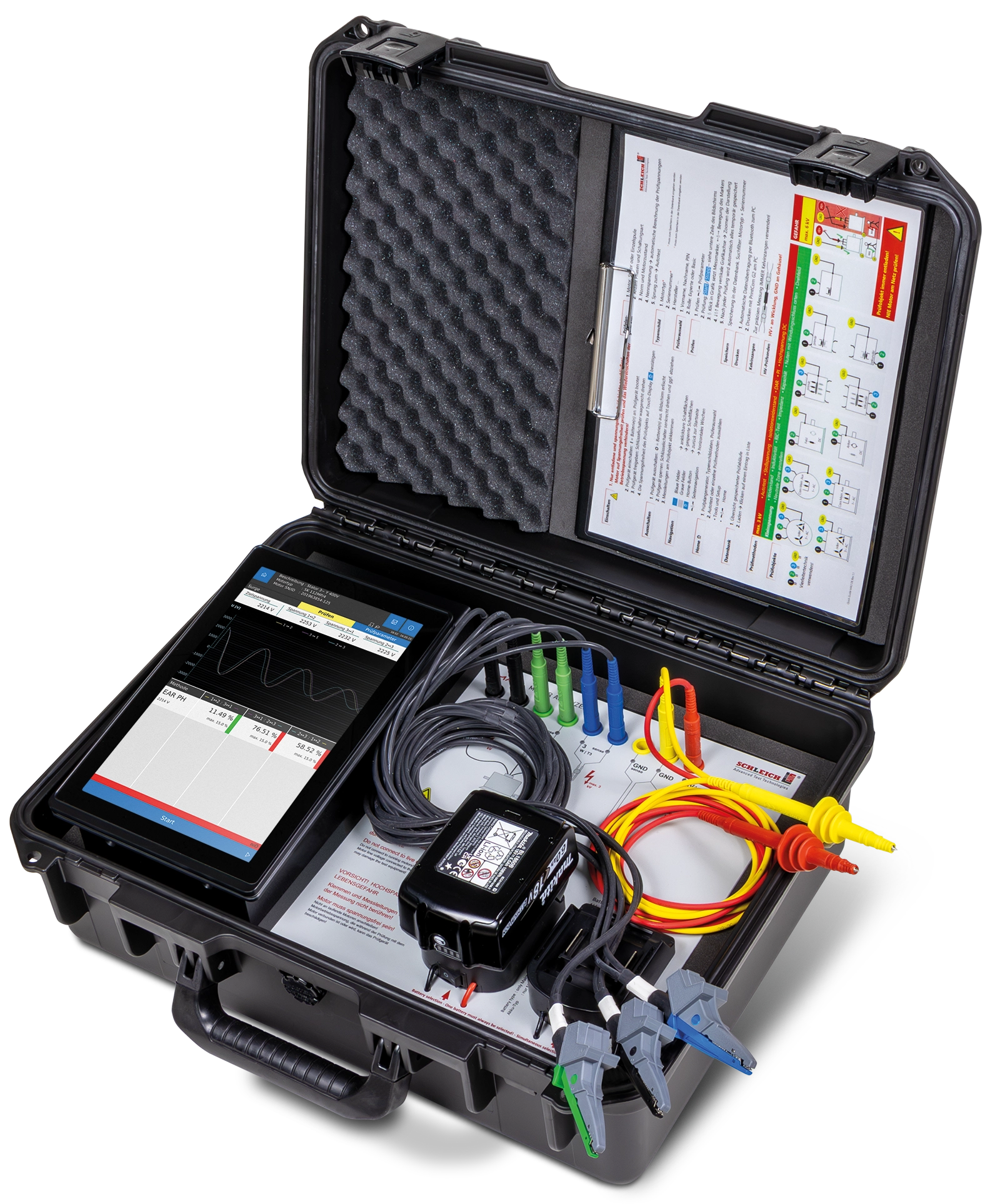



Gijsbert at IONIO is here to help you.
At IONIO, we not only supply advanced testing and measurement systems, but also offer clear and expert advice to optimise the testing of your product. Discover how we can improve your business processes. A consultation can be scheduled in no time!










Also collaborate on technical challenges?
Then you have come to the right place at IONIO!