


What does a drive do to your winding?
More and more electric motors run on a variable frequency drive. That is good for energy use and control, but it puts more stress on the winding. A drive does not switch the voltage as a sine wave, but in fast pulses with rise times of tens of nanoseconds. A standard AC test does not show how well your insulation copes with that. A square wave impulse test does.
What happens with a steep pulse
With a sinusoidal voltage, the voltage spreads evenly across the whole winding. With a steep pulse front, it does not. The voltage needs a moment to travel through the winding, so at the moment of the front it sits mainly across the first turns at the terminal.
As a result, the voltage between those first turns is much higher than the rated voltage would suggest. If the insulation is not strong enough there, partial discharge (PD) occurs. Once is not a problem. But a drive does this thousands of times per second, year after year. PD slowly erodes the insulation, and sooner or later that ends in a turn-to-turn short.

Why a conventional test does not show this
The familiar winding tests are still needed, but they look at something else:
- AC high-voltage test: checks the insulation to ground with a sinusoidal voltage. There is no steep front, so the stress between turns stays low.
- Surge test: applies a surge to the winding and compares the ringing with a reference. It finds turn-to-turn shorts that already exist. It does not show whether PD occurs with every pulse.
- PD measurement with AC: measures partial discharge, but with a waveform that looks nothing like the output of a drive.
The square wave impulse test fills that gap. You stress the winding the way the drive does, and at the same time measure whether PD occurs.
How square wave impulse testing works
The tester applies square voltage pulses to the winding, with rise and fall times of 40 to 70 nanoseconds. At the same time, an antenna picks up the electromagnetic waves released by a partial discharge. The software shows the voltage and the PD signal side by side in time. You see exactly at which pulse, and at which moment within that pulse, the discharge occurs.
In practice you raise the voltage step by step. In the SCHLEICH example nothing happens at first. Around 2.2 kV the discharge starts, and at 2.6 kV it is clearly visible on both edges. When you lower the voltage again, the PD disappears around 1.4 kV. This gives you the inception voltage, where the discharge starts, and the extinction voltage, where it stops.
You can test three insulation paths:
- turn to turn
- phase to phase
- phase to ground
Pulse shapes and voltages
| Pulse shape | Voltage |
|---|---|
| Unipolar | 3 kV |
| Unipolar | 6 kV |
| Bipolar | ±3 kV (6 kV peak to peak) |
You set the pulse width yourself. The software first shows an overview of the whole pulse sequence. One click opens a single pulse, so you can look at the voltage and the PD signal in detail.

Automatic pass or fail
In production you do not want to interpret graphs, you want a clear result. So you set two things:
- the number of pulses per test, for example 100
- the percentage of pulses that may show PD, for example 10%
The tester then decides on its own whether the winding passes or fails, and shows it in green or red. In the SCHLEICH example, a winding with 0% PD passes. A winding where 74% of the pulses show PD fails.

Applications
- Development: design and validate insulation systems for motors that will run on a drive.
- Test lab: compare insulation materials and windings under realistic pulse stress.
- Production: test every stator or winding with an automatic pass/fail result.
- Enameled wire: twisted-pair tests, where two twisted wires are stressed to assess the enamel insulation itself.
For PD measurements on electrical machines, SCHLEICH refers to the DIN EN 60034-18 series of standards.
On the SCHLEICH MTC2 R7
The square wave impulse test runs on the MTC2 R7, the universal winding analyzer from SCHLEICH. It covers the surge test, the AC high-voltage test, PD measurements and the square wave impulse test in one instrument and one test plan.
- Voltage classes 6, 12, 15, 30, 40 and 50 kV
- Surge test with up to 50 measurements per second
- Optional AC high voltage
- 4 test connections as standard, 7 or more optional
- Fully automatic test sequence

Curious what square wave impulse testing means for your windings or stators? Let us know.
Images: SCHLEICH GmbH
Related blogs
Calibration
Electric motor testing
Your calibration certificates always at hand: the new IONIO Training Portal is live
View article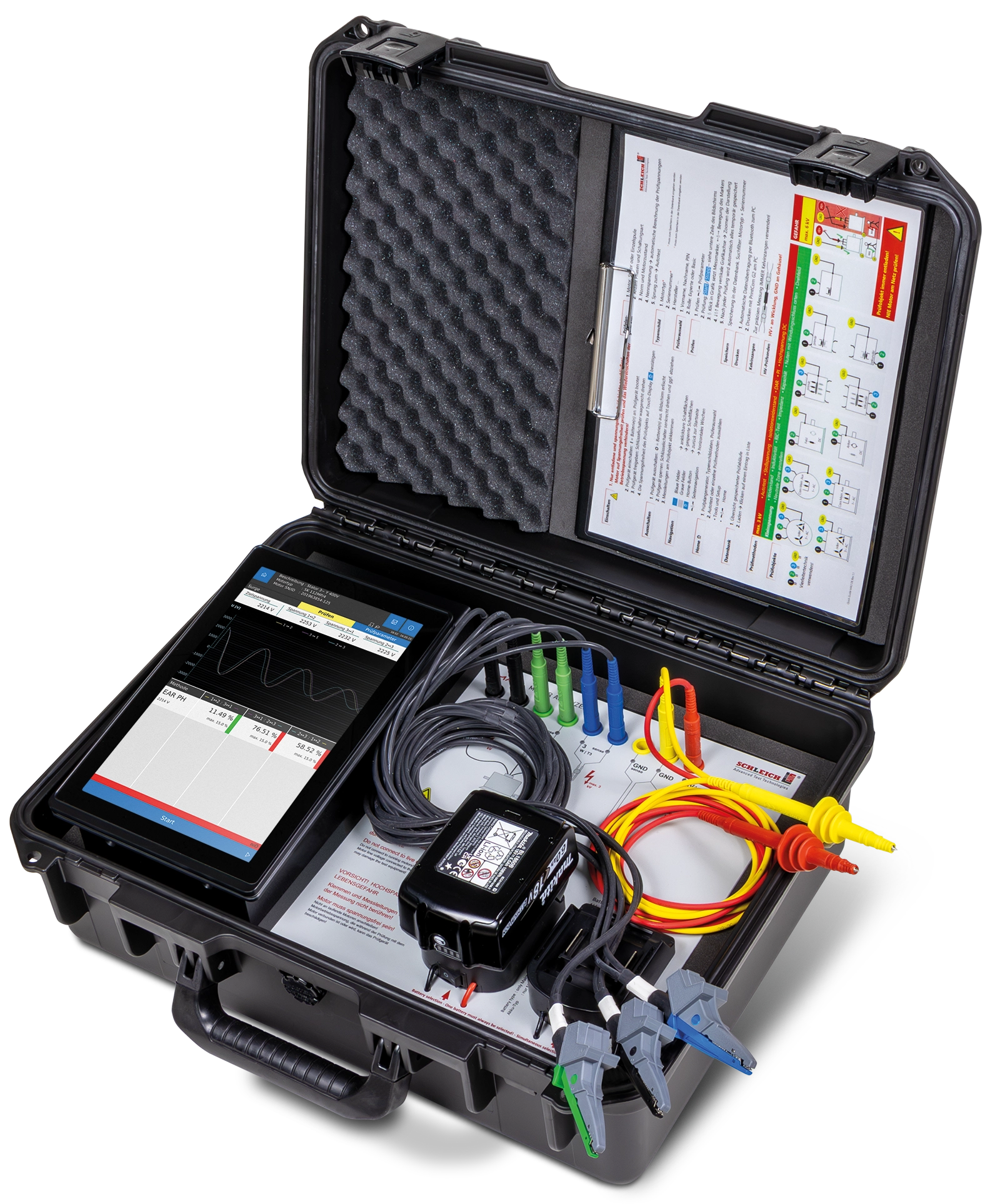


Gijsbert at IONIO is here to help you.
At IONIO, we not only supply advanced testing and measurement systems, but also offer clear and expert advice to optimise the testing of your product.
Find out how we can improve your business processes. A consultation can be scheduled in no time!










Also collaborate on technical challenges?
Then you have come to the right place at IONIO!