


Safety tests are mandatory and part of every final inspection of your electrical product. Learn the key facts about the high voltage AC test.
These tests are used to assess the insulation quality of electrical components and detect any problems.
High-voltage tests can vary in applied voltage, depending on the application and applicable standards. Generally, an AC (or DC) voltage of several kilovolts is applied to the system or equipment. The current flowing through the equipment can be high and can range from a few milliamps to several amperes.
WHY, WHERE, HOW, and also the potential danger when applying high voltage!
RIso or HV AC?
The approach to the high voltage test is very similar to the insulation resistance test. This is because both test methods deal with insulation quality. This can be done by measuring insulation resistance or by testing electrical strength with high voltage and measuring leakage current simultaneously.
However, the high-voltage test is even more “taxing” (intensive) for the device under test. It reveals weaknesses in the insulation. On the other hand, it has a disadvantage that it is not possible to display the insulation resistance exactly in MΩ or GΩ. It can therefore be useful to perform both tests in succession.
Why a high voltage test
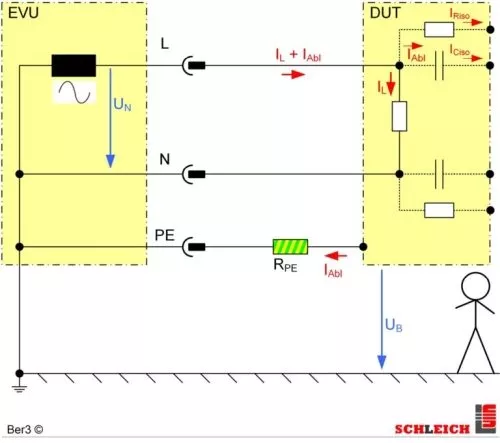
Safe insulation is the central protective measure to ensure electrical safety. It ensures that the user does not touch live conductors and that no short circuit can occur between conductors or to the equipment housing. If it does happen, a dangerous current can flow through the user when he or she touches the enclosure.
Of course, the earthing (PE) must ensure that this does not happen, which is why we always recommend carrying out the earthing measurement as the first measurement, to check correct earthing.
To guarantee all this, the insulation must be in good condition! And this must be proven and documented before the electrical product is delivered. This high-voltage test is a routine test. This means that every electrical product you put on the market must undergo a high voltage test.
Where to carry out a high voltage test
Basically, there should be good insulation between current-carrying conductors or between enclosure components. Usually this is done by insulating the electrical conductors against dangerous contact, i.e. insulating the conductors with an insulating material, this can be the insulation of the cable or additional insulating sleeving.
However, this protective sheath should be removed at the latest when the electrical conductor is connected to other electrical components. At these points, insulation is guaranteed over a safe distance. It is then a question of safety distances through clearances and creepage paths.
Moreover, current-carrying conductors can also be insulated from each other, e.g. by means of casting compounds, insulating foils or solids.
When is which type of insulation used? This is always related to the design of the electrical product, the type of specification such as high temperature or mechanical load etc. Now, it is certainly understandable that insulations in a lighting fixture, an electric iron, an electric motor or a high-voltage insulator have very different requirements and designs.
How to perform the high voltage test
Since insulation “has something to do with voltage”, the test is performed with a defined test voltage level. The aim is to measure the current through the insulation. Indeed, this is the assessment criterion for the insulation. It should not exceed a certain maximum current.
The upper current limit can vary greatly from one product to another. There is little or nothing in the standards about this limit. And there is a good reason for this – because the amount of current is highly dependent on the capacitive component in the insulation.
This test is not mandatory for all electrical products. However, it may be required for certification of the electrical product in the type test. If it is required during production, it is a routine test. That is, any electrical product you put on the market necessarily needs an AC high-voltage test.
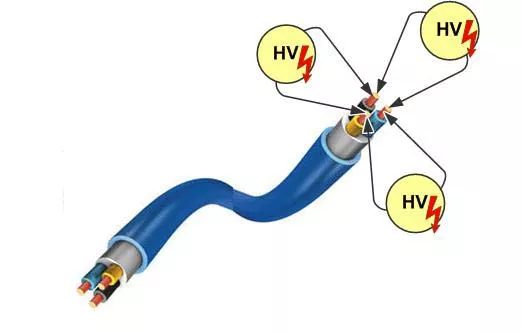
Often the high-voltage strength is measured sequentially between all the conductors involved. These may be groups of conductors or individual conductors and, of course, the housing or housing components. It soon becomes clear that the test can and should be performed in a wide variety of locations, depending on the complexity of the electrical product.
This can be done by scanning the test points with a test probe – an approach that quickly becomes time-consuming and can be costly.
Complex tests are therefore performed automatically on all test points via an HV matrix, which is fully programmable.
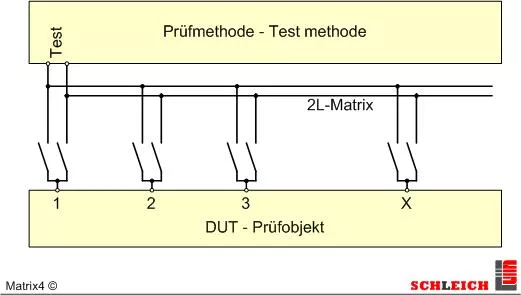
SCHLEICH matrices switch flexibly in 2- and 4-wire technology.
4-wire technology is particularly important in automated systems and installations. It ensures safe contact control of the test voltage and thus process stability.
| Test parameters | Typical norm values | SCHLEICH | from standard to customisation |
| Minimum required test voltage | 1,000 – 3,000 V AC | 50 to 100,000 V AC |
| Maximum permissible test current | 1 – 10, 50 ,100 mA | 0,1 – 5,000 mA |
| Minimum test duration | 1 s | From 0.5 s to 1 month |
| Rise time voltage | 1 s – 1 min | From 0.5 s to 1 month |
| Ramp-down time voltage | 1 s – 1 min | From 0.5 s to 1 month |
| Voltage profile | in 5 steps | In any number of steps with any profile steps |
The test current
An insulation always consists of an insulation resistor and a capacitor? Why a capacitor?
The test always takes place between two electrical conductors/poles. In an abstract way, these two poles form two metal plates facing each other. Between them lies insulation. This construction corresponds to that of a capacitor. As a result, the whole insulation structure therefore also behaves strongly capacitive.

The high voltage AC test is performed with alternating voltage. This causes a current that depends on the frequency of the test voltage to flow in the capacitive part of the insulation. The magnitude of the leakage current is proportional to the magnitude of the capacitance.
These are physical factors that have nothing to do with good or bad insulating properties of the device under test. The capacitive properties and, of course, the standard indicate the maximum allowable current. The decisive factor now is the power of the high-voltage source. It must be able to supply the required current. Otherwise, the high-voltage test would not be feasible.
Hazard in high voltage test
If an alternating current of less than 3 mA flows through the human body, it is classified as harmless according to EN50591
Therefore, if a high-voltage source can only deliver a maximum of 3 mA, it is considered a non-hazardous source. Special protective measures are not required in this case.
But a current of 3 mA is practically nothing for most high-voltage tests. Many electrical products require a significantly higher test current because of the capacitive effect. As already mentioned: this is not a rejection for the test object – but dangerous for the operator. This is because the high-voltage source is often designed for 100 mA test current. Appropriate protective measures are then absolutely necessary.
This includes:
– Electrically insulated high voltage
– Shielding of the test station
– Safety test guns
– Two-hand start with associated safety relay
– Test cage or test cabinet – double-circuit monitoring with approved safety relays and, if required, also a safe safety interlock device
– Compliance with performance level PLe, SIL3, Kat4 …
Performance level PLe, SIL3, Cat 4 …
Safety technology requirements are correspondingly high for a test current of more than 3 mA. The relevant international standards must be met worldwide. Our test equipment meets these requirements!
It should be noted that there is a wide variety of test equipment on the international market that looks like a supposed bargain but does not meet the legally required safety requirements of EN50191/VDE0104
The test systems below can pass the high-voltage AC test:
Safety tester GLP1-g
Safety tester GLP2-Basic
Safety tester GLP2-Modular
Safety tester GLP3
Surge tester MTC2
Motor test system MTC3
Related blogs

Gijsbert at IONIO is here to help you.
At IONIO, we not only supply advanced testing and measurement systems, but also offer clear and expert advice to optimise the testing of your product.
Find out how we can improve your business processes. A consultation can be scheduled in no time!










Also collaborate on technical challenges?
Then you have come to the right place at IONIO!