Home / Products / High voltage tester GLP2-Basic HV


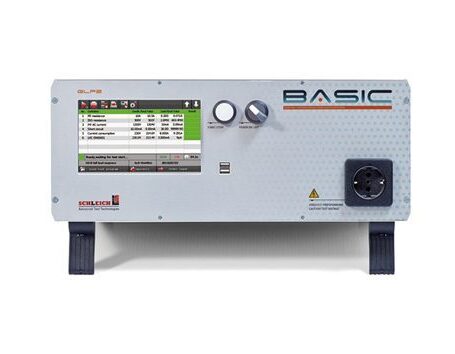

High voltage tester GLP2-Basic HV
The GLP2-Basic HV is the version of the Schleich GLP2-Basic that only performs the high-voltage test. AC up to 6 kV is built into the tester. For 15, 30 or 50 kV a separate high-voltage transformer is added. DC goes up to 6 kV.
When do you choose the GLP2-Basic HV?
You only need a high-voltage test, without a protective earth, insulation or function test. Think of cable reels, windings, insulating material or a test set-up in a test cage. If you are looking for a tester that combines more test methods, take a look at the GLP2-Basic with up to 21 test methods.
There are seven variants: 320, 330, 440 and 530 up to 6 kV, and 360, 370 and 380 up to 15, 30 and 50 kV. They are listed under Product variant.
15, 30 or 50 kV with an external transformer
On the 360, 370 and 380, the high-voltage transformer stands next to the tester. You connect the test object directly to the transformer, through a tube with a ball as the connection point. The tester itself weighs 13 kg and controls and measures the test.
- 360: 125 to 15,000 V in steps of 10 V, max. 50 mA, 750 VA; transformer approx. 20 kg
- 370: 250 to 30,000 V in steps of 50 V, max. 30 mA, 900 VA; transformer approx. 25 kg
- 380: 400 to 50,000 V in steps of 50 V, max. 25 mA, 1000 VA; transformer approx. 45 kg
Schleich shows a test set-up for cable reels in a test cage as an example.
Controlling and measuring the voltage
The test voltage is a sine wave according to EN 61180. A PID controller corrects the voltage every 100 µs. You measure the voltage as True RMS, as peak value or as peak value divided by √2. For the current you choose between total current, active current and reactive current. The tester switches the voltage on and off at the zero crossing. The frequency follows the mains (47 to 63 Hz); as an option you set 50 or 60 Hz, independent of the mains.
Four test modes
- Automatic: with test timer and ramps; the tester switches off when the current is too high
- Manual: without test timer; the tester switches off when the current is too high
- Burn: without test timer, the tester does not switch off and limits the current to 100 mA (100 mA variants only)
- Pulsing: when the current is too high, the voltage switches off for 0.5 s (not on the 3 mA variant)
Long tests
The test timer runs from 0.1 s to 200 hours. You set the voltage ramp-up and ramp-down each from 0.1 s to 24 hours. The timer only starts once the test voltage is reached. After each test the tester discharges the test object itself. Keep the test leads connected until the discharge is complete.
Breakdown, flashovers and contact faults
The tester fails the test when the current exceeds the set limit. A du/dt analysis for breakdown is also available. With a lower current limit you see whether a contact or a cable is broken. The trip time on overcurrent is 20 to 30 ms. With AC, the ARC detection counts short flashovers of less than 10 µs, which a normal current measurement hardly picks up.
Same platform as the GLP2-Basic
Operation, test plans, reports, network, fieldbus and safety according to EN 50191 are the same as on the GLP2-Basic. That page explains how they work. The HV comes with a traceable calibration certificate; for calibration and service you can come to IONIO.
Answers to your questions about the high voltage test (HiPot)
What is a Hipot measurement?
Is a high voltage test dangerous?
What is a high voltage test?
What is the point of a high voltage or hipot test?
What is high voltage?
Is a High-voltage AC or DC?


Gijsbert at IONIO is here to help you
At IONIO, we not only supply advanced testing and measurement systems, but also offer clear and expert advice to optimise the testing of your product.
Discover how we can improve your business processes.