


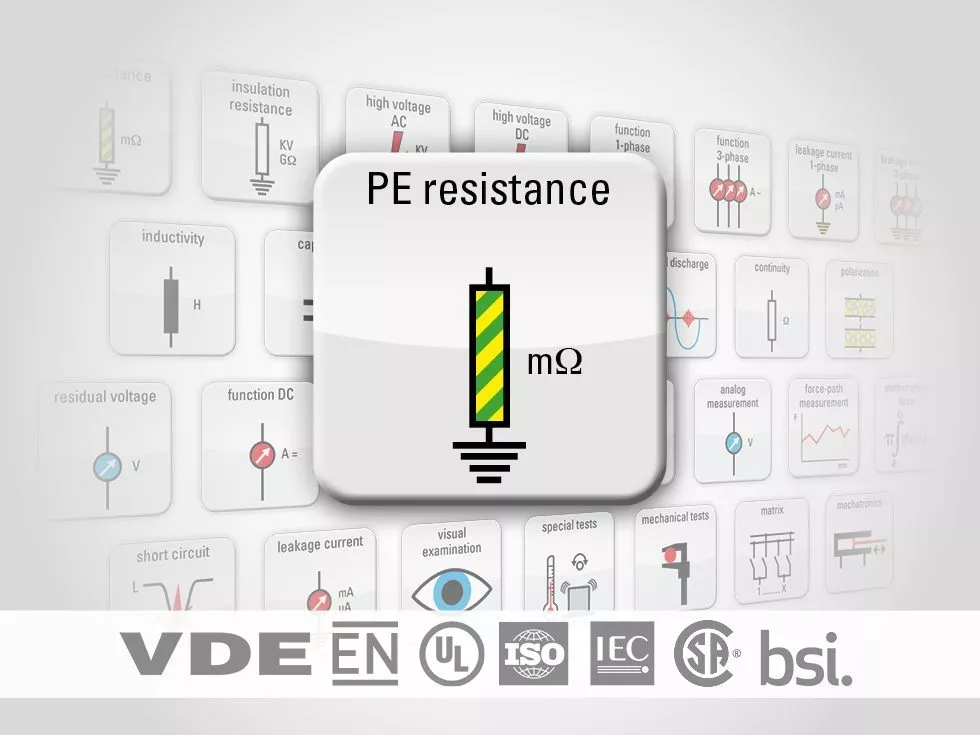
Safety testing is mandatory and an essential part of the final inspection of electrical products.
Earthing measurement, also known as ground resistance measurement or as abbreviations PE (Protective Earth), GB (ground bound), is an important test used to assess the quality of the earthing of electrical systems and equipment. Proper earthing matters for the safety of electrical installations and the prevention of electric shock.
To perform the earthing measurement properly, we need to ask ourselves the following questions: why, where, how and when not?
Why is this measurement so important? The protective conductor (earthing) is the central protective measure to ensure the electrical safety of a product. It ensures that no dangerous voltage is present on the device housing in the event of a fault. If this does happen and a user touches the housing, a dangerous current can flow through the body. Therefore, the protective conductor should at least reduce and, at best, completely eliminate the danger to persons.
It is therefore crucial that the earthing measurement is carried out correctly and documented before delivery of the electrical product. The protective conductor resistance test is a routine test that must be carried out for every object, i.e. every electrical product placed on the market.

Where?
The most critical defect is a total short circuit between a phase and an electrically conductive part of the device housing. If a user now touches the housing, this can lead to an electric shock. This dangerous situation must be avoided! For this, all electrically conductive parts of the enclosure must be safely connected to the central protective conductor.
In the worst case, the protective conductor must be able to discharge a complete short circuit between the phase and a conductive part of the enclosure to earth. The very high short-circuit current will be present during a fault and will remain present until a fuse blows and the equipment is de-energised.
During this time, no excessive touch voltage should be generated on any part of the enclosure. However, this can happen if the resistance of the protective conductor is too high.
Therefore, all internal and external earth conductor connections should be checked for correct operation. This is done either by testing various parts of the enclosure using a test probe. Or, if all individual enclosure components are connected to the test device using test leads, fully automated.
How?
To simulate the high current load of the protective conductor as realistically as possible, the test of the protective conductor is performed with a high test current, this current is usually 10A (Europe) or 25A (USA), but for type tests it can be as high as 40, 75 or 100 amps.
The test voltage is defined in many standards as an AC voltage less than 6 or 14 volts, the grounding measurement can also be made with a DC in some cases.
The rating of the test is the ohmic resistance or voltage drop. It should not be too high, otherwise the contact voltage on the equipment will be too high in case of damage.
The upper grounding limit may be defined differently from product to product and in different regions/continents. Therefore, you should take the test parameters from the standard applicable to the product and region, usually the maximum value in a PE measurement is 100 milliOhm.
The grounding measurement will be done with a four-wire measurement to compensate for the transition resistance and the resistance of the measuring cables.
| Test parameters | Typical standards | SCHLEICH | from standard to customisation |
| Maximum permissible PE resistance | 100 – 200 – 500 mΩ | from 0.0001 to > 10 Ω |
| Minimum test current required | 10 – 30 A (AC or DC) 200 mA |
from 0.1 to > 100 A (AC or DC) |
| Maximum permissible test voltage | 6/12 V 6 – 24 V |
from 6 to> 24 V |
| Minimum testing time | 1 s | from 1 s to 24 hours |
When not?
Electrical products of protection class II have reinforced or double insulation of the housing. The housing does have electrically conductive components, but these cannot be live due to their design. Such products are therefore electrically safe to touch due to their construction. They therefore do not need a protective conductor. Thus, no PE measurement is possible or necessary.
Which systems have a ground measurement?
Our GLP1-g, GLP2-Basic, GLP2-Modular and the MTC3 and GLP3 can be fitted with a ground measurement.
Related blogs

Function tester
High-voltage tester
Testing light management today: from DALI to DMX. What you really need to safeguard in production
View article
Electric motor testing
Function tester
Hot hipot during functional testing: maximum assurance that all circuits are active
View article
Gijsbert at IONIO is here to help you.
At IONIO, we not only supply advanced testing and measurement systems, but also offer clear and expert advice to optimise the testing of your product.
Find out how we can improve your business processes. A consultation can be scheduled in no time!










Also collaborate on technical challenges?
Then you have come to the right place at IONIO!