


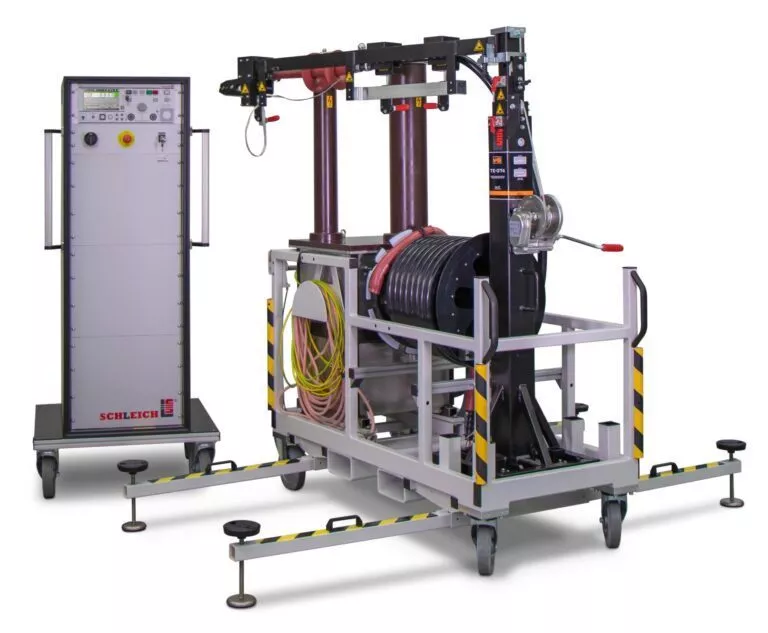
Rail vehicle testing can be a very exciting business. Exciting because the test voltage can reach up to 30 kV! And, of course, with a high test current too. Therefore, high-voltage, high-power sources are needed for the insulation test of rail vehicles.

But the design of the high-voltage tester is also quite unusual compared to the normal laboratory setup. Who wants to stand right next to a 30 kV system?
For this obvious reason, and often for reasons of spatial constraints, a split device is the ideal design for such applications.


The video impressively demonstrates what a high-voltage test on rail vehicles can look like.
The tester is divided into two units:
The device in the foreground contains the complete control electronics including the voltage control of the high-voltage transformer. The device behind it consists of the actual high-voltage transformer – supplemented by a cable winding drum and an extendable telescopic column. Through this telescopic column, the high-voltage test cable is lifted to the roof of the rail vehicle, where it is then clamped to the pantograph.
The opposite pole is the entire chassis of the rail vehicle.
Related blogs

Gijsbert at IONIO is here to help you.
At IONIO, we not only supply advanced testing and measurement systems, but also offer clear and expert advice to optimise the testing of your product.
Find out how we can improve your business processes. A consultation can be scheduled in no time!










Also collaborate on technical challenges?
Then you have come to the right place at IONIO!