


Home / Blog / 4 Draads Weerstandsmeting Kelvin Meettechnologie
05-06-2025
4-wire resistance measurement Kelvin measurement technology
The Kelvin measurement technique, also known as the 4-wire measurement technique, is a method of measuring the resistance of a component with high accuracy and avoiding measurement errors.
This technique is often used when measuring very low resistance values (milliOhm) , where the resistance of the measuring leads and contact resistors can have a significant influence on the measurement.

The image above shows a resistor Rx and two test probes. The test probes have two contact points/contact surfaces that are isolated from each other. Thus, there are a total of four connection points on the resistance to be measured.
In 4-wire measurement (also called Kelvin measurement technique), this measurement method is used to compensate for the transition resistance between the test probe and the test object. The resistance values of the measuring leads are also compensated.

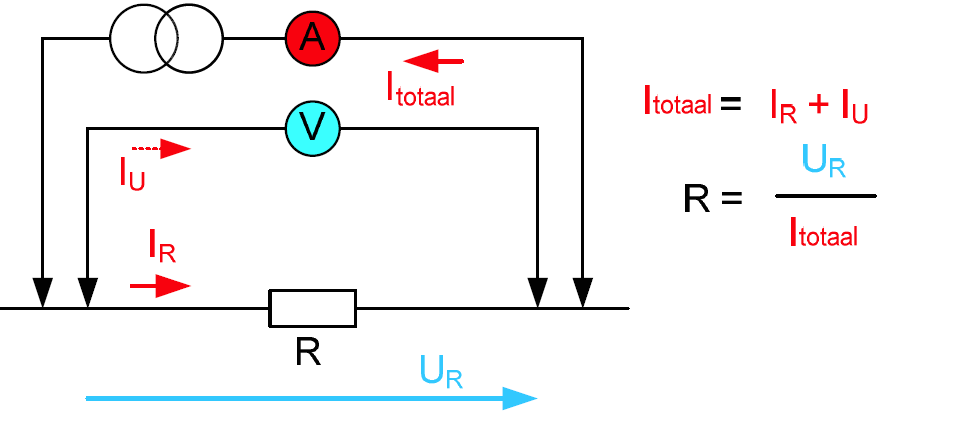
In the four-wire measurement, the voltage drop is measured with a high-impedance voltmeter. The figure above shows a replacement diagram of the measurement circuit.
One contact provides the power supply to the test object and the second contact provides the voltage drop measurement using a high-ohmic voltmeter.
We use this measurement technique as standard in our test systems with earth (PE – GB) and ohmic resistance (R) measurements.
The internal resistance of the voltmeter is in the MOhm / GOhm range, but a small current still flows. The total current consists of the current through the voltmeter and the current through the resistance to be measured. Using a calculation, we can show that the current through the voltmeter is almost negligible.

With a resistance of 0.1Ω and current of 2.5A, this results in a voltage across the resistor of 0.25V.
Assume further that the internal resistance of the voltmeter is 10MΩ.
This results in a measurement current through the voltmeter of 25 nA (nano Amps!) That makes a proportion of the current through the voltmeter of 0.000001%!
The current through the voltmeter is very low. To connect the test object in four-wire measurement, we offer different clamps in different sizes for easy connection of your test objects.

Four-wire matrix for resistance measurement
The four-wire measurement can also be used with matrix testers. In this case, four relay contacts per connection point on the test object are necessary. This allows each connection point to be measured relative to each other. With this method, the corresponding current relay and voltage relay (sense) are always switched simultaneously.

Using the matrix in 4-conductor measuring technique, one can perform various complex measurements on a wide variety of products.
We apply the four-wire measurement to our systems with resistance measurement and earth ground measurement — including the ARES 200D micro-ohmmeter and the GLP2-Basic R resistance meter. Contact IONIO to discuss your measurement application.
Related blogs

Calibration
Electric motor testing
Your calibration certificates always at hand: the new IONIO Training Portal is live
View article


Gijsbert at IONIO is here to help you.
At IONIO, we not only supply advanced testing and measurement systems, but also offer clear and expert advice to optimise the testing of your product.
Find out how we can improve your business processes. A consultation can be scheduled in no time!










Also collaborate on technical challenges?
Then you have come to the right place at IONIO!