


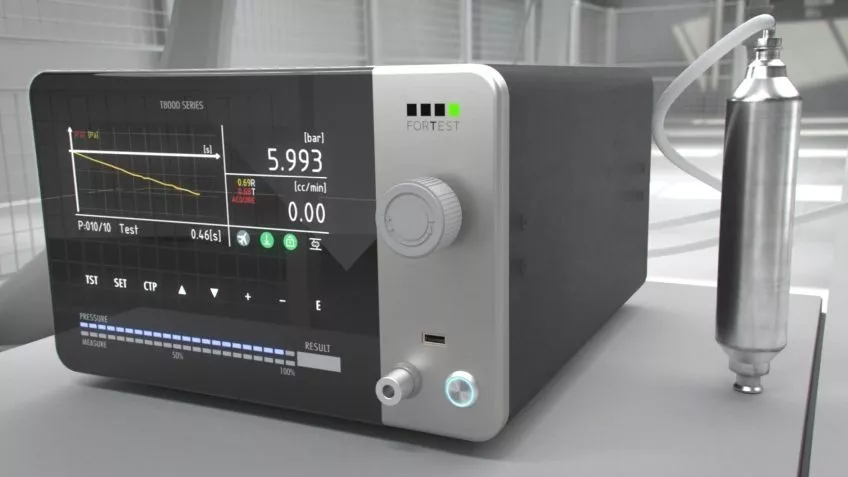
Dual Absolute®
Currently, we know of two common types of leakage testers, based on absolute decay, or relative, and based on differential decay.
Although the measurement quality of the two types of equipment is described and defined in a standard, the scope of the different methods is not always clear and well defined, and in practice the two systems often overlap.
This is also a consequence of the fact that the technologies and components have evolved over the years; the basic principles have been taken to a higher level and provide ever better performance. This applies both in terms of the control software and the available variants, options and pneumatic modules that were not yet foreseen in the original circuits. Equipment has been extended to include functionality and elements such as sample volumes, electronic controllers, capacity meters, vacuum generators and coaxial housings, to improve effectiveness and reliability.
A variant that is now starting to gain more prominence is the Dual Absolute technology.
This new system, also called Dual Absolute leak tester, is not an optional extension or intermediate form of the two previous types of measurement, but offers new features that improve the quality of measurements and simplify the two existing, previous basic types.
Differential systems were originally created with the dual purpose of being able to measure pressure decay with higher resolution and compensate for the temperature gradient of the component being measured. The technology has since improved exponentially with the addition of strain gauges and electronic pressure transducers, increasing the quality of systems with absolute decay.
A similar comparison could be made between dynamometric scales and an unster balance with sliding weights. Although comparison-based scales appear to be unprecedentedly accurate, over time these systems have given way to measuring with strain gauges and the application of electronics has meant that the precision and ease of use of the new scales far exceed those of all previous mechanical systems. The cost of the new systems is lower, they require less maintenance and mechanical parts, and they are more efficient and reliable.
The resolution of Δp/Δt
As with a gravimetric dosing system, the measurement resolution factor plays an important role in the quality of the application, perhaps even more so than the overall long-term accuracy characteristic of a leakage testing system based on pressure decay.
In numerical terms, referring to the technical data provided on the internet by the various leak tester manufacturers, one can see that the widespread standard at present is to guarantee a resolution of 0.1 Pa to 16 bar for differential systems, reduced to 3 bar for leak testers based on absolute decay.
This means that if we install a pressure transducer, e.g. with a scale of +/- 50 millibars, in a differential system and compare it with the direct pressure of a tester operating on the basis of absolute decay and having a maximum scale of 3000 millibars, the two measurements operate in the same way in terms of Δp/Δt resolution. If we were instead to install a 6-bar pressure transducer in the absolute system, the resolution would deteriorate by a factor of two, i.e. double to about 0.2 Pa per division.
It is clear that differential systems, given their greater mechanical complexity, offer advantages mainly in terms of compensating the measurement in terms of temperature and mechanical stress of the product, and to a lesser extent in terms of pressure decay accuracy.

Technical considerations
Regarding the resolution, some purely technical considerations apply.
The first is that in practice, among the thousands of issues for which ForTest has provided a solution, some 90% are within the 6-bar pressure, while 60% are within a 3-bar test pressure. So even if the difference in terms of benefits is already minimal, in more than one in two cases, using a differential gauge offers no advantage, even theoretically, in terms of resolution.
Moreover, for applications above 6 bar, it is not advisable to set a decay threshold at the end of the gauge’s resolution. In fact, it turns out that the higher the test pressure is, the more the decay to be measured increases proportionally. In practice, at pressures above 8 bar, it is strongly discouraged to set a Δp below 100 Pa; in such situations, a resolution of 0.1 or 0.2 Pa does not change anything at all, except if done intentionally.
The final consideration is that these resolution data are usually measured at zero, i.e. compared with base values at ambient pressure. In practice, little is known about the actual behaviour in terms of resolution hysteresis; all that is known is derived from laboratory tests performed at leakage and sample volumes at real test pressures. That is, a diaphragm, whether absolute or differential, subjected to differential pressure (or normal operation in differential testing) is inevitably subjected to mechanical noise and stress that are not considered in the conditions for certification.
It goes without saying that the quality of the differential pressure transducer, which is the “heart” of these systems, largely determines the metrological quality of the devices on the market, as well as their reliability in terms of withstanding pressure spikes and suitability for use in high humidity or polluted air or test products present at the test.
Temperature compensation
Whereas over the years the technology of pressure sensing and digitisation of force and pressure signals has significantly reduced the differences between different measurement systems in terms of resolution, the problems related to the compensation of thermal and mechanical variations have remained unchanged. In this scenario, differential systems still play a major role.
When analysing pressure decay measurements (symmetric differential) compared to this sample product, there are still two cases, opposite to each other, where absolute leakage testers show drawbacks. This is namely the case of tests on components with very small volumes and very high productivity (tyre valves, fittings, biomedical components, etc…), where cycle time is the most important and measurement speed is a decisive parameter, and for large test volumes where the influence of deviations and temperature elasticity is too great not to compensate.
The fact is that alternative metering systems have shown more suitable solutions than differential meters in both cases. For example, systems for recovering compliance or interception in the bell jar for small volumes and mass flow for large products.
Research is under way to improve the application of differential systems. In this framework, we focus on balancing the sample component, partly because the concepts of absolute, differential and dual measurement are in fact completely at odds with the different types and apply in different ways to the physical principles of the pressure transducers used.
Measurements on low-volume products
With regard to measurements on small-volume components, with a view to reducing test times (e.g. 1.2 s for the total cycle from start to end, 1cc test, leak = 10 cc/h at 2 bar), and although absolute measurement has a very high dynamic range and does not require the long stabilisation times required for differential systems, we note that mechanically balancing the differential pressure transducer is even more direct and faster in practice than is the case with a dual system (such as Dual Absolute®).
This means that with such a short time Δp/Δt (typically 100/200 ms) to realise the decay, even small signal phase shifts of the two diaphragms, or their resonances, lead to large overall measurement errors. Such errors do not occur at all if the bandwidth is limited to below 100 Hz on the signal slopes, i.e. with a time Δp/Δt of more than half a second. In these cases, however, “ultra-fast” in micro-volume applications, traditional differential pneumatic circuits are absolutely preferable, but adapted as much as possible with micro-valves, pressure transducers and small tubes.
While in these specific microvolume conditions, the pressure decay that occurs during a leak is always of large magnitude, the application of pressure transducers, even those with a low dead volume, such as MEMS or solid-state bridges, instead of capacitive pressure transducers, simplifies the problems of rupture and reliability and allows for a very high dynamic measurement scale, albeit with more limited resolution.
This is at odds with measuring high-volume products, where it is necessary to ensure that measurements are as stable as possible and do not suffer from noise and anomalies, even at the expense of bandwidth. Here, resolution and stability in measurements up to 60/120 seconds are the special features. In all cases of direct measurement, it should be borne in mind that the leakage ratio is always inversely proportional to the pressure drop Δp/Δt. In these cases, it is better to have designed all possible conversion bits offering AD components, as well as larger filters and immunity to EMC.
Regardless of the conditions of small parts, the physical and pneumatic scenario when measuring large-volume parts, from over 250 cc, where a certain sensitivity is required, is quite different. Within this context, all manufacturers of measuring equipment, including ForTest, have researched systems that contribute to the use of reference sample parts.
Much of the software algorithm-based technology provides for characterising when a test result is considered “good” or falls within a band of extreme certainty, in order to mimic a dynamic offset in an “anti-transient” manner and continuously apply tuned dynamic offset compensation (DOC) to the measurement. Systems already widely deployed are auto-zero algorithms for the most popular weighing systems, which in fact only partially adapt to the broader problem of complex leakage testing processes.

The downside of these systems and alternative solutions
The main drawback of these offset correction systems is their inability to split and correct several errors one by one. Regardless of the actual effectiveness of these automatic offsets, they can be helpful if used in small percentages of the set point, as they are only used to detect slow/very slow variations of the error. In general, however, the quality of the overall measurement is affected by various parasitic phenomena due to the overlapping of various factors such as mechanical movements, stress on materials, elasticity of the fittings connecting parts and also, but only partially, by fluctuations in ambient temperature.
Other commonly used systems allow sampling the trend of environmental factors through temperature sensors, creating an offset compensation expressed in Pa/C° (DOCT). After analysing the practical tests during production, i.e. processing the measurement results in Excel and correlating them with the measured temperatures, in this operating mode we apply a correction factor to the measurement to compensate for temperature variations. Although these algorithms require more work to develop, they offer the advantage of only compensating the temperature behaviour and avoiding an excessive accumulation of aspects to be corrected.
In all cases, ensuring equilibrium via a sample product or reference element contributes significantly to the stability and repeatability of the measurement, for example for obtaining ambient temperature data.
Differential and repeatability meters. It should be borne in mind that differential leakage testers are often used in three practical configurations, which can be broadly summarised as follows:
Asymmetric differential, i.e. with the reference side capped. This is a simplification at the installation stage that makes this system similar to an absolute system
Differentieel met de nul in het midden, ontworpen om twee producten tegelijk te meten.
Symmetric differential, the truly balanced comparator, where the reference side is connected to an airtight sample product.
We now analyse the benefits of different forms of using reference sample parts.
Of these three configurations, the symmetrical configuration with a sample product offers the best options in terms of accuracy, repeatability and, in particular, the absence of noise due to temperature and mechanical stress.
Microvolume applications
In microvolume applications, where in practice the tubes connecting to the product are the overriding thermal mass and expansion elements, the use of a reference circuit that is as similar as possible to the measurement side makes it possible to perfectly balance the system and, in addition to temperature, also correct the expansion of the two sides of the circuit (test and reference), since small test products are generally rigid. In these cases, a simple identical tube sealed on the reference side and the same length as the tube connected to the test is more than enough to obtain both excellent repeatability and a drastic reduction in stabilisation times. For metal parts, a blind appendage as a cap on the end of the reference tube provides a temperature recording function that further improves the application.
Higher-volume applications
This is no longer true in the second case of using a differential tester, i.e. in the most common applications where parts are tested with a volume that is itself larger than the dead volume of the connecting tubes. To add complexity to this already complex scenario, problems arise when the tests are repeated on the same component because of the mechanical stress on the components and the endogenous generation of parasitic temperatures.
In fact, when using sample parts in practice, and contrary to the desired measurement compensation, the difference in volume due to the expansion of the two parts being tested also leads to errors in the measurement again. In a differential pressure decay measurement system, which is normally intended for high-speed industrial production, the mechanical expansion of the part being tested will be limited to the measurement activity, while the mechanical stress on the reference sample part will accumulate for the entire time the device is in use, which may be an indeterminate number of times. This leads to all the effects of continuous deviations in the behaviour of the two products already after 15 to 30 minutes of production at constant speed.
In these cases, the expansion of the tubes or circuits within the instruments is no longer the dominant factor, as in micro-volume applications, but it is the products themselves that cause the repeatability error.
Analogously, as a result of the continuous pressure and the fact that only the reference sample product is emptied, thermal energy accumulates more and more, creating endogenous phenomena that largely impede compensating measurement and lead to undesirable deviations.
In practice, empirical studies have shown that a metal part with a volume of 300 cc subjected to a pressure of 2 bar takes at least 20 minutes to recover in terms of elasticity and temperature, i.e. to come back within a margin of repeatability of 10% compared to the first test performed.
For this reason, the concept of apparent repeatability has been introduced over time in the use of differential pressure decay meters, i.e. the phenomenon of good repeatability when repeating measurements on the same component, measurement stability per gram, which is then not maintained during practical use in production.
The birth of Dual Absolute systems
Dual Absolute systems were created in response to these problems of deviation and voltage faced by the reference products. In a first version, or rather during the experimentation phase, these systems were presented as a simple expansion set for normal absolute and differential devices. Via a three-way valve, a sampling procedure was then introduced, i.e. automatic “self-learning” of offsets of the dynamic offset, with time frequencies fast enough to follow the evolution of the ambient temperature, but providing sufficient time for rest on the reference side to return to the original elasticity condition, i.e. the actual elasticity condition to be compared with the products being tested. Several manufacturers use the same systems from time to time for sampling ambient conditions (ambient temperature and pressure) using sampling heads and as a convenient means of compensating volume flow measurements.
Over time, thanks to a successful combination of positive factors and all for the purpose of product improvement and savings, the creation of two symmetrical branches of absolute measurement independent of each other, but controlled by different types of software, has led to an unparalleled improvement in all types of pressure measurement.
This not only enabled better symmetric measurements, but it also offered the possibility, thanks to different methods of test management, to significantly improve both the central zero measurement and the asymmetric type.
Absolute measurement where absolute-decay meters were always considered the “worst” system, recent improvements in information acquisition and pressure sensing have greatly increased the popularity of absolute-decay meters and they are now often combined with differential and mass flow testers.
This success is due not only to the actual quality of the measurement, but also to its tremendous ease of maintenance and use, robustness and reliability compared to other leak testers. Besides the basic concept of plc, valve and pressure transducer, we have realised accurate and versatile machines with a more direct approach to leak testing through the systematic development of hardware and firmware over time.
It is always important to keep an eye on the environment in which devices are used (generally not in the ideal laboratory and or under sterile conditions) where even the simplest things can quickly become complicated.
Although this system appears less sensitive than other systems on a small scale, the high dynamics during stabilisation and during measurement of absolute decay and the absence of limits to high pressure have led to this system being preferred for applications for which differential and mass flowmeters are less suitable. For example, in the biomedical field, where the need for reliable airtightness, sterility and prevention of contamination of the components being tested as well as the high vibration properties of elastic materials, e.g. for use as pouches or transfusion kits, have meant that these systems are now prescribed as standard.
It goes without saying that with a wide range of technological solutions and different measurement methods, ranging from tracer gases to micro-flows and from recovery to pressure decay systems, the right approach for the application always offers the most appropriate solution, firstly in terms of purpose and scope, then in terms of sensitivity and finally in terms of the cycle time required.
Advantages of absolute-decay meters
The fact is that the use of an absolute-deviation system, where possible, always offers the advantage of “install and forget”, while any other method with a dual sensor requires a bit more attention due to the double measurement. Indeed, this requires regular, more careful verification and checking for anomalies and, in any case, double certification. For example, in the case of mass flowmeters (which reduce interventions related to capillary systems and make them simpler), it is always necessary to check the quality of the air being used and the degree of contamination or deterioration of the measurement sensor.
With differential drop systems in particular, wear and fouling of the compensating valves are inevitable due to the drain required to maintain the life of the pressure transducer, while the pneumatic system is much more sensitive and sophisticated than any other system.
Although the pneumatic and mechanical design and periodic verification and calibration procedures of all systems have greatly improved over time, it is immediately obvious that all these technologies are more complicated than testers that measure absolute decay.
In this type of tester, only one pressure transducer is used. It is of extremely high quality and covers the entire measuring range. It is very robust, requires no forced discharge at the end of the test, resists the influence of water due to unsynchronised discharges from the outside of the instrument, is not particularly sensitive to dirt and is insensitive to the dielectric capacity of the gas used and, within certain limits, its humidity. Moreover, the simple pneumatic system is accompanied by mostly standard commercially available components, is oil- and silicone-free, and comes with certificates for food, packaging and pharmaceutical applications if required. The pneumatic system is thus easy to maintain and, if properly designed, intrinsically safe, or, in case of failure, always in decay. All these features are difficult to obtain in pneumatic systems for differential measurement systems, with a symmetrical structure or without a main axis, and with isobaric cavities. Therefore, this second type of device requires more frequent maintenance and more precise periodic checks.
For example, in our differential T8960 leakage testers, we looked at the possibility of using commercial valves to exploit the advantages of interchangeability and versatility of absolute decay models, leaving compensation and protection of the pressure transducer to software procedures and fast PWM signals rather than mechanical components.
In practice, it is difficult to decide which system is the most practical to use. For example, how do you know whether it is better to use a diesel or a petrol engine? That hybrid is the future?
Dual technology
As mentioned above, the new dual systems did not emerge as intermediate solutions between the meters we know today, but as solutions in addition to, and improving on, them wherever possible. Based on the characteristics of both types that are now known, they are basically aimed at bringing together their functions and simplifying and extending the measurement cycles. They combine the reliability and safety of absolute systems with the “amplifier effect of decay” of differential decay systems.
The key differentiators
Although it is still too early to define standards given the state of research and development of software in different modes, it is already possible to give a brief description of systems based on Dual Absolute technology.
The most salient point becomes clear when comparing the use of a symmetric differential system with a product. In this case, the strategy is to sample the reference product at least during the test phase, as is also done in a differential system, but at such intervals that a correct comparison with the tested product can be made, without distortion of the elastic and thermal properties of the reference product. These samples, in turn, are stored in vector mode and compared with the ongoing tests, to allow a virtual comparison for a new sampling.
The evidence of improvement is then even stronger when used in symmetric differential mode at the central zero point; this has been completely abandoned by existing differential systems, which are considered unreliable due to measurement uncertainty in case of leakage on both sides. In this mode, the power of the dual system is fully realised: the advantages of symmetric compensation can be exploited and the system is safe at the same time. In practice, the measurement cycle in this mode provides an extension of the test time only in case of deviation from absolute values by detecting a low differential factor. In other words, this makes it possible to benefit both from the high insensitivity to mechanical stress from the environment and temperature deviations due to true symmetric equilibrium, and from the reliable simplicity of absolute decay.
In asymmetric differential operation, the software concentrates instead on the ability to exhaust the air only when required. Because there is no need to secure the pressure transducer, it is no longer necessary to generate an exhaust phase at the end of the test, as required for differential gauges. This allows the two measurement sides to be kept under pressure as much as possible, stabilising them and avoiding complicated isobaric mechanics, coaxial tubes and other anti-expansion devices aimed at reducing elasticity phenomena inside the instruments. In practice, emptying takes place where possible at the beginning of the test, rather than at the end, and control takes place by interception by the software when the operator or test bench is about to empty the product being tested.
Conclusion
This is a summary of the specifics of the new technology described here. In addition to these aspects, measurement certification is always and only inherent in a relative measure and in practice all the simplicity and reliability of a system with absolute decay is observed.
In practice, even if the Pascal resolution is a few decimal places less and at operating pressures above 6 bar, there is a simplification compared to the best-known differential systems.
This technology no longer revolves around the differential pressure transducer, but keeps the hardware to a minimum while the software is constantly evolving.
We therefore invite both technicians and equipment manufacturers to contact ForTest / IONIO B.V. for tests and additional information and to test this promising new technology for themselves.
Related blogs

Gijsbert at IONIO is here to help you.
At IONIO, we not only supply advanced testing and measurement systems, but also offer clear and expert advice to optimise the testing of your product.
Find out how we can improve your business processes. A consultation can be scheduled in no time!










Also collaborate on technical challenges?
Then you have come to the right place at IONIO!