


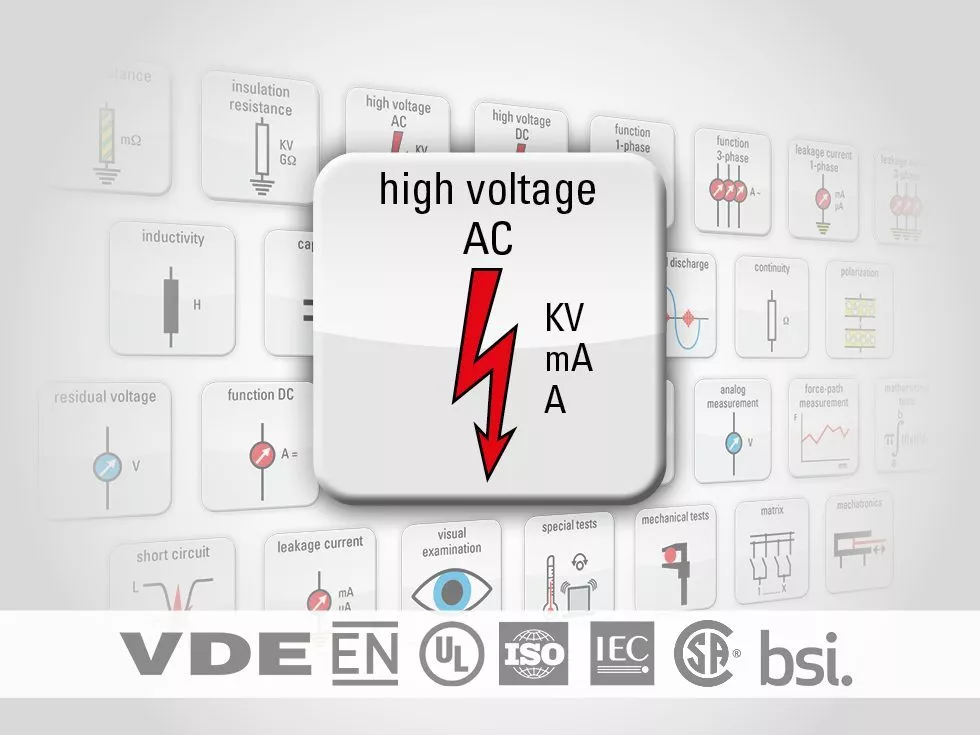
The high voltage AC (alternating current) test serves to test the electrical insulating properties and voltage resistance of electrical components, modules, machines, devices and systems according to various national and international regulations.

The level of the test voltage, the duration of the test, the type of test and the maximum allowable leakage current is defined in the various standards. The high voltage test is basically performed on the same connections as the insulation resistance test.
However, unlike the insulation resistance test, the high voltage test is performed with much higher test voltages. The test voltage can be either AC or DC.

When testing with AC, both ohmic insulation resistance and capacitive insulation resistance current are detected. So a total current is calculated from the ohmic and capacitive part, this also makes the final current higher compared to measurements with a DC voltage.
For electric motors in particular, this can sometimes lead to a very high current being required for the high-voltage test. This high current is present because the capacitance of an electric motor is very high.
As an alternative to testing with AC, it is also possible to test with DC. This has the advantage that, as in the insulation resistance test, only the ohmic insulation resistance is detected after a charging time of the capacitance.
In the high-voltage test, the conductive current (leakage current) should never exceed a certain limit. If this limit is exceeded, the test voltage is immediately and automatically switched off.
It is also possible to pre-set a minimum current. Especially for test objects, where a capacitive current flows, it is possible to pre-set a minimum current. Once the minimum current is reached, you can be sure that the test object is under high voltage.
This control of minimum current is particularly easy in the high voltage AC test.
However, the minimum current is also possible in the high-voltage DC test.
When switching on the high-voltage DC test, the capacitance in the test object is briefly charged. This charging current pulse can be detected and serves as the minimum limit.

High-voltage tests are often performed at several test points by manually contacting the test points with high-voltage test guns.
It is also possible to build fully automatic test devices with extended matrix (switch-over) for automatic testing at different HV test points. There is virtually no limitation for the number of matrix points.
What test devices does IONIO B.V. supply?
Individual testers
Manual testing via test guns
Matrix of up to 500 terminals and fully automatic switching
Testers with 100 kV AC
Testers with 100 kV DC
DC high voltage modules
Remark:
For legal reasons, in many cases we cannot make a mandatory statement on the test conditions. Important for the application is the currently applicable standard for testing your product.
Depending on the geographical location of the product, the standards to be applied may vary. For more information, please refer to your national inspection authority.
Need more capacity? Rent high-voltage test capacity.
Related blogs

Function tester
High-voltage tester
Testing light management today: from DALI to DMX. What you really need to safeguard in production
View article
Electric motor testing
Function tester
Hot hipot during functional testing: maximum assurance that all circuits are active
View article
Gijsbert at IONIO is here to help you.
At IONIO, we not only supply advanced testing and measurement systems, but also offer clear and expert advice to optimise the testing of your product.
Find out how we can improve your business processes. A consultation can be scheduled in no time!










Also collaborate on technical challenges?
Then you have come to the right place at IONIO!