


Home / Blog / No Load Current The Key To Assessing Voltage And Power Transformers
18-01-2026
What is a no-load current?
When a transformer is energised but not supplying any load, it draws a specific current: the no-load current (also known as magnetising current or magnetisation current).
This current may seem simple, but it is actually a powerful indicator.
This current may seem simple, but in reality it is a powerful indicator of:
- the magnetic health of the core
- possible winding defects
- asymmetry between phases
- saturation behaviour
- insulation and manufacturing issues
The no-load current shows exactly how the transformer behaves magnetically when it is “at rest”. This is precisely why the no-load current measurement (no-load test, magnetization measurement, magnetization analysis, or V–I magnetization curve measurement) is so valuable in maintenance, overhaul, and quality control.
Why is the no-load current so important?
A healthy transformer exhibits predictable magnetic behaviour. The no-load current is fully determined by:
- the material and structure of the core
- the winding ratio and geometry
- insulation condition
- manufacturing quality
- any damage or short circuits
An increased no-load current may indicate:
- core saturation
- loose or damaged laminations
- shorted turns (indirect indicator only: the no-load test is less sensitive to winding faults than winding resistance or surge testing)
- moisture or contamination in the insulation
- mechanical deformation due to transport
- errors in the connection scheme
Because the secondary side is open, deviations are often quickly reflected in the core and windings. However, note that residual magnetism, tap position, connection method, and supply quality can also influence the measured values.

The phase angle: the second half of the story
The phase angle between voltage and no-load current provides insight into the relationship between:
- Inductive component – responsible for magnetizing the core – lags the voltage by nearly 90°
- Active component – related to core losses (hysteresis + eddy currents) – in phase with the voltage
In a healthy transformer, the phase angle is typically around 70–85° inductive. The no-load phase angle is generally strongly inductive (large phase angle, low cos φ). As core losses increase or (incipient) saturation occurs, the phase angle becomes smaller (the phase angle here refers to the lag angle between voltage and current; a higher active component increases cos φ and thus reduces the lag angle).
A smaller phase angle indicates:
- higher core losses
- saturation
- damaged core laminations
- insulation faults (especially in VT/PTs)
No-load current in voltage transformers (VT/PT)
For voltage transformers, the no-load current is highly sensitive and crucial for the accuracy class.
Deviations in no-load current directly lead to:
- phase errors (with impact on protection relays)
- deviating voltage ratios
- measurement errors within classes 0.2, 0.5, 1.0
Therefore, a no-load current measurement is essential for VT/PTs during:
- acceptance testing
- periodic maintenance
- fault analysis
A small issue in the core can quickly become a major problem in the measurement chain.
No-load current in power transformers
In large transformers, the comparison between phases is particularly important.
What should you look for?
- No-load current per phase
- Phase angle per phase
- Symmetry between phases
- V–I magnetization curve
A deviation in just one phase may indicate:
- core damage due to short-circuit currents
- manufacturing deviations
- transport-related deformation
- Condition issues (moisture/contamination) that can contribute to additional losses
Note: inherent phase asymmetry: in a three-phase transformer with core-type construction (E-I core), the centre limb has a shorter magnetic path than the outer limbs. The no-load current of the centre phase is therefore structurally lower. This is a design characteristic, not a defect. Always compare phase against phase over time (trending) rather than relying solely on absolute values between phases.
For overhaul companies and grid operators, this is one of the most valuable early-warning measurements.
How do you measure no-load current and phase angle?
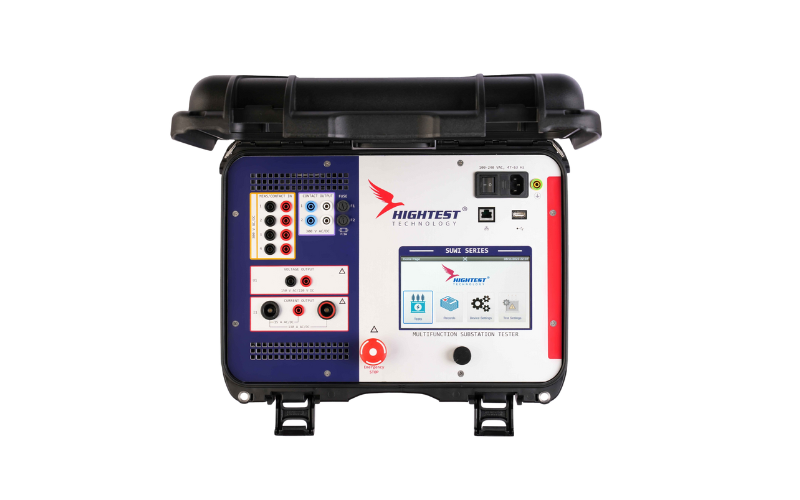
With modern systems such as the Hightest TRAN-203, you can:
- measure no-load current (per phase)
- determine phase angle
- generate magnetization curves
- visualize core saturation
- analyze asymmetry
- detect manufacturing defects without load
Normative framework
The no-load test is a routine test as specified in IEC 60076-1 clause 11.1 (power transformers) and the IEC 61869 series (voltage transformers VT/PT, successor to IEC 60044-2). IEEE C57.12.90 covers the equivalent test procedure for the North American context. Acceptance criteria for no-load current and no-load losses are established in the factory test report in accordance with these standards; deviations are evaluated against design values and previous measurement series.
Compare no-load current only at the same tap position, the same nominal frequency, and with a supply voltage that is as sinusoidal as possible. Deviations in waveform or frequency significantly affect the measured no-load current and no-load losses.
Interpretation: what does it mean in practice?
Healthy transformer
- low no-load current
- large inductive phase angle
- three nearly identical phases
- smooth magnetization curve
Deviating transformer
- increasing no-load current
- decreasing phase angle
- clear phase imbalance
- kinks or jumps in the curve
These patterns indicate early stages of:
- winding faults
- core problems
- mechanical damage
- insulation issues
Conclusion
A no-load current measurement (magnetization measurement / no-load test / magnetization analysis)
is one of the most powerful yet most underestimated diagnostic tools for voltage and power transformers.
The combination of no-load current + phase angle provides a complete picture of:
- core quality
- winding condition
- insulation status
- symmetry
- saturation
- mechanical integrity
For engineers, overhaul companies, and grid operators, this forms an essential foundation for a reliable power supply.
Measuring no-load current in practice
The TRAN-203 Series transformer analyser from IONIO measures no-load current, phase angle and related parameters in one measurement run. Suitable for three-phase transformers up to 20 A / 250 V. Contact IONIO for advice on your measurement application.
Related blogs


Metrology
Substation testers
Temperature rise test (Heat Run test) on transformers: practical guide
View article
Metrology
Substation testers
What is a micro-ohm measurement and what do you need to know?
View article
Also collaborate on technical challenges?
Then you have come to the right place at IONIO!

Gijsbert at IONIO is here to help you.
At IONIO, we not only supply advanced testing and measurement systems, but also offer clear and expert advice to optimise the testing of your product.
Find out how we can improve your business processes. A consultation can be scheduled in no time!